


Two little labels that tell you whether a French verb touches its object directly — or reaches it through a preposition first.
Je regarde la télé.
vs.
I watch TV (straight to the object)
Je parle à mon professeur.
I talk to my teacher (via the word "à" first)
It's simple: a COD (complément d’objet direct) comes directly after the verb, without a preposition. A COI (complément d’objet indirect) is introduced by a preposition such as à or de. Learning to identify the preposition makes it easy to understand the difference between COD and COI in French grammar.
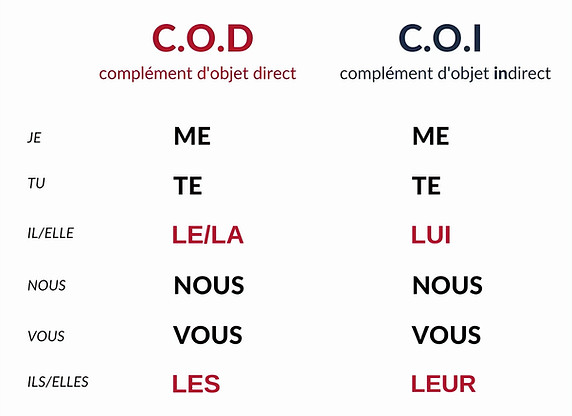
Le complément d'objet direct (COD)
The COD is directly connected to the verb. There is no preposition between the verb and the COD. Simplistically, nothing sits between the verb and object.
To find the COD, ask:
-
QUI → Who?
-
QUOI → What?
Examples
-
Il mange une pomme.
He eats an apple. — mange quoi? → une pomme -
Nous invitons nos amis.
We're inviting our friends. — invitons qui? → nos amis -
Tu connais ce restaurant ?
Do you know this restaurant? — connais quoi? → ce restaurant
SIMPLE RULE
Subject + Verb + COD
Je regarde le film.
There is no preposition between regarde and le film.
Le complément d'objet indirect (COI)
The COI is connected to the verb by a preposition, most commonly à. That little word "à" is the "bridge" b/w the verb and the object. (The proposition "De" is not discussed here, to keep the explanation simple and easy to understand.)
To find the COI, ask:
-
À QUI → To Whom?
Examples
-
Je parle à Marie.
I am speaking to Marie. — Je parle à qui ? → à Marie = COI -
Il téléphone à son père.
He calls his father. — Il téléphone à qui ? → à son père = COI -
Nous écrivons à nos amis.
We write to our friends. — Nous écrivons à qui ?→ à nos amis = COI
SIMPLE RULE
Subject + Verb + à + COI
Je parle à Marie.
There is a preposition between the verb parle and the object Marie: à.
COD ou COI ?
The easiest way to distinguish COD and COI is to look at the relationship between the verb and the complement.
The COI is connected to the verb through a preposition, almost always à. That little word is the "bridge" — it's the tell.
COD
Qui ? / Quoi ?
No preposition
Je regarde Paul.
J'aime Marie.
Il cherche son téléphone.
Nous écoutons la musique.
COI
À qui ?
Usually with à
Je parle à Paul.
Je téléphone à Marie.
Il répond au professeur.
Nous écrivons à nos amis.
Compare
COD
Je regarde Paul → I am looking at Paul.
→ Je regarde qui ?
→ Paul = COD
COI
Je parle à Paul. → I am speaking to Paul.
→ Je parle à qui ?
→ à Paul = COI
The same person can therefore be a COD with one verb and a COI with another verb.
50 Common verbs with a COI
Some common French verbs that follow à + person.
-
parler à — to speak to
-
téléphoner à — to call
-
répondre à — to answer
-
écrire à — to write to
-
obéir à — to obey
-
désobéir à — to disobey
-
ressembler à — to resemble
-
appartenir à — to belong to
-
plaire à — to please
-
sourire à — to smile at
-
nuire à — to harm
-
convenir à — to suit
-
penser à — to think about
-
participer à — to participate in
-
s’adresser à — to speak to / address
-
faire confiance à — to trust
-
renoncer à — to give up
-
contribuer à — to contribute to
-
assister à — to attend
-
croire àto believe in
-
tenir à — to care about / be attached to
-
réfléchir à — to think about
-
s’habituer à — to get used to
-
s’attendre à — to expect
-
se fier à — to rely on / trust
-
se consacrer à — to devote oneself to
-
s’opposer à — to oppose
-
s’adapter à — to adapt to
-
s’ajouter à — to be added to
-
s’attacher à — to become attached to
-
s’appliquer à — to apply oneself to
-
se joindre à — to join
-
s’identifier à — to identify with
-
faire appel à — to call upon / appeal to
-
avoir recours à — to resort to
-
recourir à — to resort to / use
-
se conformer à — to comply with
-
se référer à — to refer to
-
se soumettre àto submit to
-
s’attaquer à — to tackle / attack
-
se comparer à — to compare oneself to
-
se substituer à — to replace
-
pardonner à — to forgive
-
succéder à — to succeed / replace
-
manquer à — to be missed by
-
obtenir grâce à — to obtain through
-
faire attention à — to pay attention to
-
faire face à — to face / deal with
-
être fidèle à — to be faithful to
-
être reconnaissant à — to be grateful to
50 Common verbs with a COD
Some common French verbs directly followed by their object.
-
aimer — to like / love
-
adorer — to love
-
détester — to hate
-
préférer — to prefer
-
regarder — to watch
-
écouter — to listen to
-
chercher — to look for
-
attendre — to wait for
-
connaître — to know
-
acheter — to buy
-
prendre — to take
-
manger — to eat
-
boire — to drink
-
lire — to read
-
comprendre — to understand
-
apprendre — to learn
-
inviter — to invite
-
aider — to help
-
trouver — to find
-
voir — to see
-
entendre — to hear
-
rencontrer — to meet
-
visiter — to visit
-
utiliser — to use
-
choisir — to choose
-
porter — to wear / carry
-
ouvrir — to open
-
fermer — to close
-
commencer – to begin
-
terminer — to finish
-
faire — to do / make
-
écrire — to write
-
dire — to say
-
raconter – to tell
-
demander — to ask for
-
recevoir — to receive
-
envoyer — to send
-
donner — to give
-
préparer — to prepare
-
réparer — to repair
-
vendre — to sell
-
perdre — to lose
-
gagner — to win
-
oublier — to forget
-
accompagner — to accompany
-
suivre — to follow
-
quitter — to leave
-
appeler — to call
-
connaître — to know
-
remplir — to fill
Les pronoms COD
A COD can be replaced by a COD pronoun to avoid repeating the noun.
French
me / m'
te / t'
le / l'
la / l'
nous
vous
les
English
me
you
him/it
her/it
us
you
them
Examples
-
Je regarde le film. → Je le regarde.
I watch it. -
Elle connaît Marie. → Elle la connaît.
She knows her. -
Nous achetons les livres. → Nous les achetons.
We buy them. -
Il écoute la radio. → Il l'écoute.
He listens to it.
Les pronoms COI
A COI introduced by à can often be replaced by a COI pronoun.
French
me / m'
te / t'
lui
nous
vous
leur
English
to me
to you
to him/her
to us
to you
to them
Examples
-
Je parle à Marie. → Je lui parle.
I speak to her. -
Il téléphone à ses parents. → Il leur téléphone.
He calls them. -
Nous écrivons à Paul. → Nous lui écrivons.
We write to him. -
Elle parle à ses amis. → Elle leur parle.
She speaks to them.
COD or COI pronoun?
This is one of the most common difficulties for French learners.
Aimer → COD
-
J'aime Marie. → Je l'aime.
❌ Je lui aime.
Parler à → COI
-
Je parle à Marie. → Je lui parle.
❌ Je la parle.
Regarder → COD
-
Je regarde Paul. → Je le regarde.
Téléphoner à → COI
-
Je téléphone à Paul. → Je lui téléphone.
Remember
COD → le, la, l', les
COI → lui, leur
COD and COI with pronouns together
When a sentence contains both a COD and a COI, both can be replaced by pronouns.
Examples
Je donne le livre à Paul.
-
le livre = COD
-
à Paul = COI
→ Je le lui donne.
I give it to him.
Elle montre les photos à ses amis.
-
les photos = COD
-
à ses amis = COI
→ Elle les leur montre.
I give it to him.
You can learn more about the position and combination of object pronouns in a separate lesson on Les pronoms compléments.
Attention aux prépositions
The presence of à can help identify a COI, but not every phrase beginning with à is a COI.
Examples
Je parle à Paul.
→ à Paul = COI
But
Je vais à Paris.
→ à Paris indicates a place/destination, not a COI.
Therefore, always look at the relationship between the verb and its complement.
Common mistakes
The presence of à can help identify a COI, but not every phrase beginning with à is a COI.
Mistake 1
❌ Je lui aime.
✅ Je l'aime.
Aimer takes a COD.
Mistake 2
❌ Je la parle.
✅ Je lui parle.
Parler à quelqu'un takes a COI.
Mistake 3
❌ Je le téléphone.
✅ Je lui téléphone.
Téléphoner à quelqu'un takes a COI.
Mistake 4
❌ Je lui regarde.
✅ Je le regarde.
Regarder quelqu'un takes a COD.
Exercises
Exercise 1
Identify the COD or COI
Exercise 2
Qui, quoi, à qui or à quoi?
Exercise 5
Replace the complement with a pronoun
-
Je regarde la télévision.
-
Elle parle à son professeur.
-
Nous achetons une voiture.
-
Il téléphone à sa mère.
-
Tu connais Paul.
-
Ils écrivent à leurs amis.
-
Je cherche mes clés.
-
Elle répond au professeur.
-
Nous écoutons la musique.
-
Il donne un cadeau à Marie.
-
Je regarde le film. → Je regarde ______ ?
-
Elle parle à Paul. → Elle parle ______ ?
-
Nous achetons une maison. → Nous achetons ______ ?
-
Il téléphone à sa sœur. → Il téléphone ______ ?
-
Tu connais Marie. → Tu connais ______ ?
-
Elle répond au professeur. → Elle répond ______ ?
-
Nous écoutons la radio. → Nous écoutons ______ ?
-
Il écrit à son ami. → Il écrit ______ ?
-
Vous cherchez vos clés. → Vous cherchez ______ ?
-
Elle pense à son travail. → Elle pense ______ ?
-
Je regarde le film.
-
Elle connaît Marie.
-
Nous achetons les livres.
-
Je parle à Paul.
-
Il téléphone à ses parents.
-
Elle écrit à son professeur.
-
Tu invites tes amis.
-
Nous aidons notre professeur.
-
Elle répond à ses parents.
-
Ils écoutent la musique.
Exercise 4
Choose the correct pronoun
-
Je regarde Marie. → Je la / lui regarde.
-
Je parle à Marie. → Je la / lui parle.
-
Il connaît Paul. → Il le / lui connaît.
-
Il téléphone à Paul. → Il le / lui téléphone.
-
Nous aimons nos parents. → Nous les / leur aimons.
-
Nous parlons à nos parents. → Nous les / leur parlons.
-
Elle écoute ses amis. → Elle les / leur écoute.
-
Elle répond à ses amis. → Elle les / leur répond.
-
Tu invites tes cousins. → Tu les / leur invites.
-
Tu écris à tes cousins. → Tu les / leur écris.
Exercise 3
COD or COI?
-
Marie in Je connais Marie.
-
à Paul in Je parle à Paul.
-
le livre in Je lis le livre.
-
à sa mère in Il téléphone à sa mère.
-
les étudiants in Le professeur aide les étudiants.
-
à ses amis in Elle écrit à ses amis.
-
un café in Je prends un café.
-
au professeur in Il répond au professeur.
-
la musique in Nous écoutons la musique.
-
à son frère in Elle donne un cadeau à son frère.