


The definite articles in French are used to refer to a specific person, thing, place or concept, or to something that is known or already identified. In English, the definite article is simply “The”. In French, it changes according to the gender and number of the noun.
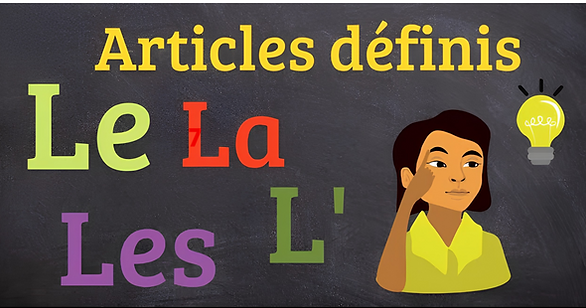
The Four Definite Articles
-
Le - Masculine - Singular - Eg: Le tableau
-
La - Feminine - Singular - Eg: la table
-
L' - Before a vowel or silent h - Eg: l'école
-
Les - Plural - Eg: les étudiants
Le — Masculine - Singular
le livre — the book
le garçon — the boy
le professeur — the teacher
le téléphone — the telephone
le café — the coffee
La — Feminine - Singular
la table — the table
la voiture — the car
la maison — the house
la fille — the girl
la chaise — the chair
When Do We Use Definite Articles?
D. With Parts of the Body - Especially when another expression already identifies the person.
-
J'ai mal à la tête.
I have a headache. -
Il se lave les mains.
He washes his hands. -
Elle ferme les yeux.
She closes her eyes.
E. Definite Articles with Countries
Feminine countries
-
la France
-
la Belgique
-
la Suisse
-
l'Inde
Masculine countries
-
le Canada
-
le Portugal
-
le Japon
-
le Brésil
Plural countries
-
les États-Unis
-
les Pays-Bas
L' — Before a Vowel or Silent H
l'école — the school
l'ami — the friend
l'hôtel — the hotel
l'université — the university
l'histoire — the history/story
Les — Plural
les livres — the books
les garçons — the boys
les filles — the girls
les maisons — the houses
les écoles — the schools
A. For Something Specific or Identified - When we are talking about something specific or already known.
-
Ferme la porte.
Close the door. -
Le professeur est dans la classe.
The teacher is in the classroom. -
J'aime la voiture de Paul.
I like Paul's car.
B. For General Ideas or Things - when talking about something in a general sense.
-
J'aime le chocolat.
I like chocolate. -
J'aime la musique.
I like music. -
Les chiens sont intelligents.
Dogs are intelligent. -
Le français est une belle langue.
French is a beautiful language.
F. Definite Articles with Languages.
-
Je parle le français.
-
Elle apprend l'anglais.
-
Il comprend l'espagnol.
-
Nous étudions l'allemand.
NOTE
C. With Days of the Week - To indicate a regular or recurring activity.
-
Je travaille le lundi.
I work on Mondays. -
Nous avons cours le mardi.
We have class on Tuesdays.
However, after certain verbs such as parler, the article is often omitted in expressions such as:
-
Je parle français.
-
Elle parle anglais.
Both forms can be correct depending on the structure and context.
NOTE
Without the article, a day can refer to a particular day.
-
Je travaille lundi.
I am working on Monday.
Exercises
Exercise 1 — Choose the Correct Article
Exercise 2 — Complete the Sentences
Exercise 3 — Correct the Mistakes
-
___ livre
-
___ maison
-
___ école
-
___ garçons
-
___ voiture
-
___ hôtel
-
___ professeur
-
___ étudiants
-
___ université
-
___ table
-
J'aime ___ musique.
-
___ chien est dans le jardin.
-
Elle ferme ___ porte.
-
Nous étudions ___ français.
-
___ enfants jouent dans le parc.
-
Il habite en ___ France.
-
___ école est grande.
-
J'aime ___ chocolat.
-
___ professeur arrive.
-
Elle se lave ___ mains.
-
La école est grande.
-
Le maison est belle.
-
La garçon est intelligent.
-
Le enfants jouent.
-
La hôtel est près d'ici.
-
Le voiture est rouge.
-
Le université est moderne.
-
La ordinateur est sur la table.
-
Le filles sont dans la classe.
-
La professeur arrive à huit heures.